Can You Pet A Seal If It Hugs You?
Why a seal that looks like it wants a hug should never be touched, and how Wellington seal safaris keep you at a safe, legal distance.
No. Touching a seal is illegal in New Zealand regardless of how friendly the animal appears, and a seal resting on its back with crossed flippers is not hugging, it is thermo-regulating. The Marine Mammals Protection Act 1978 makes harassing or disturbing a seal an offence carrying up to two years in prison or a fine up to $250,000.
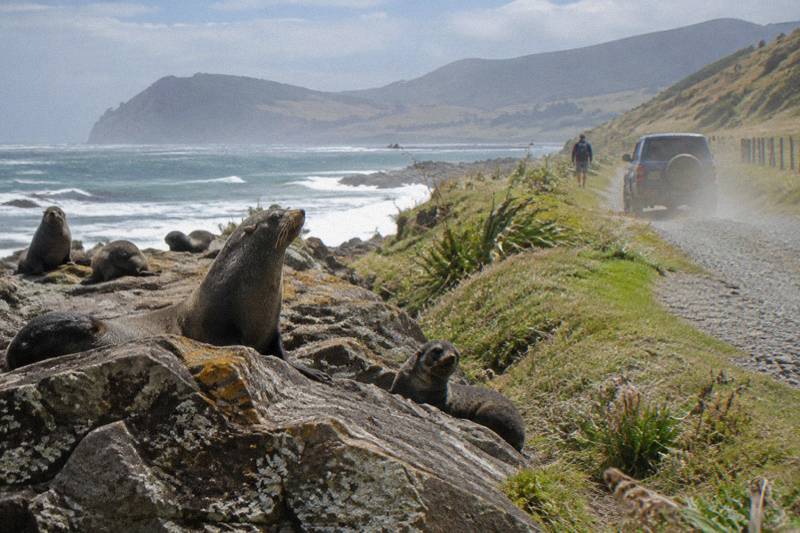
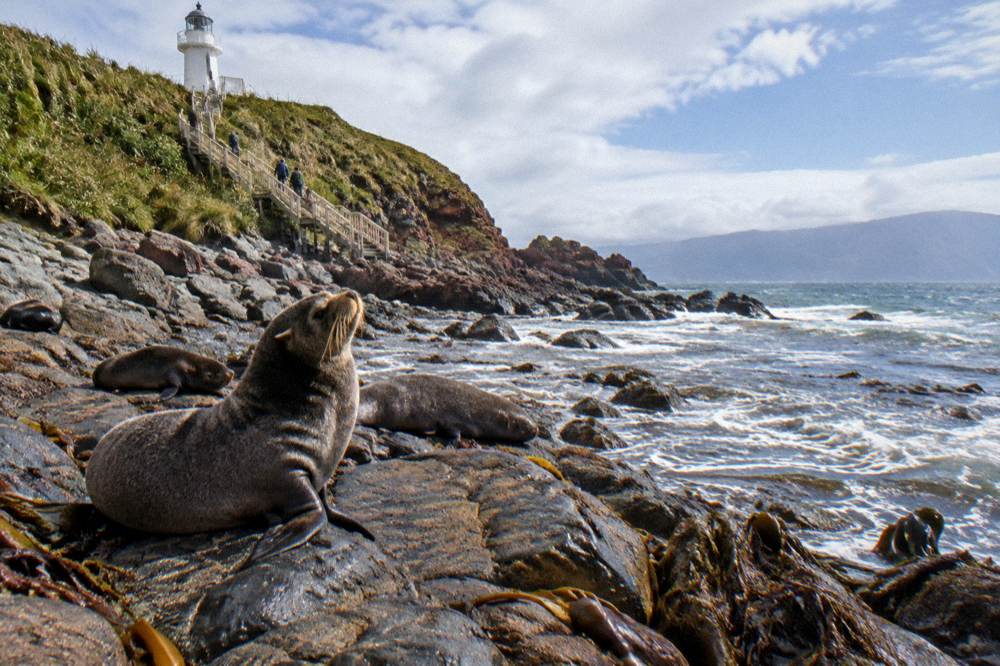
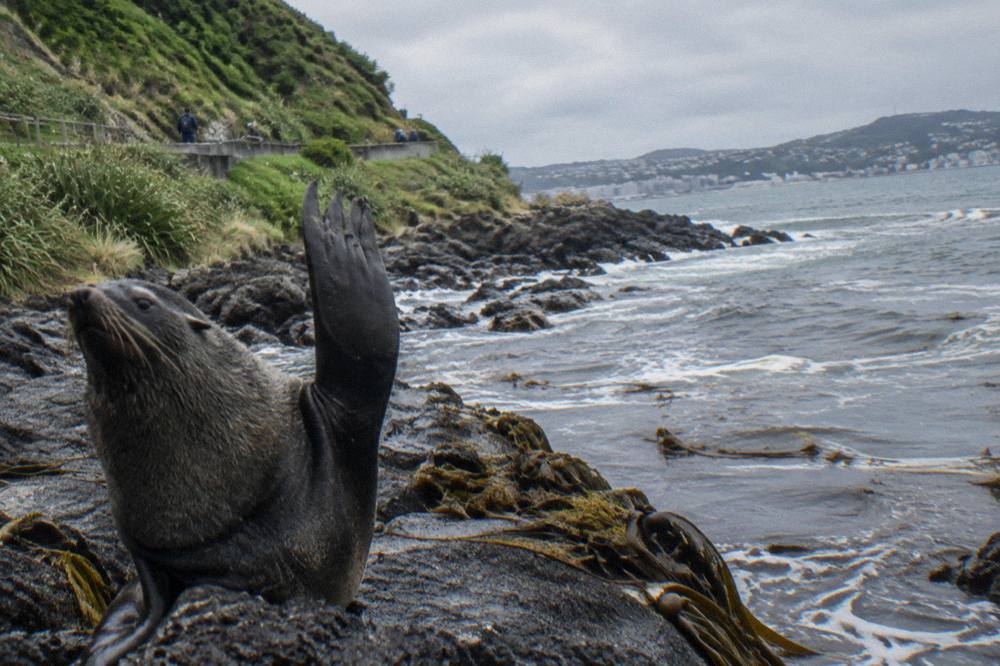
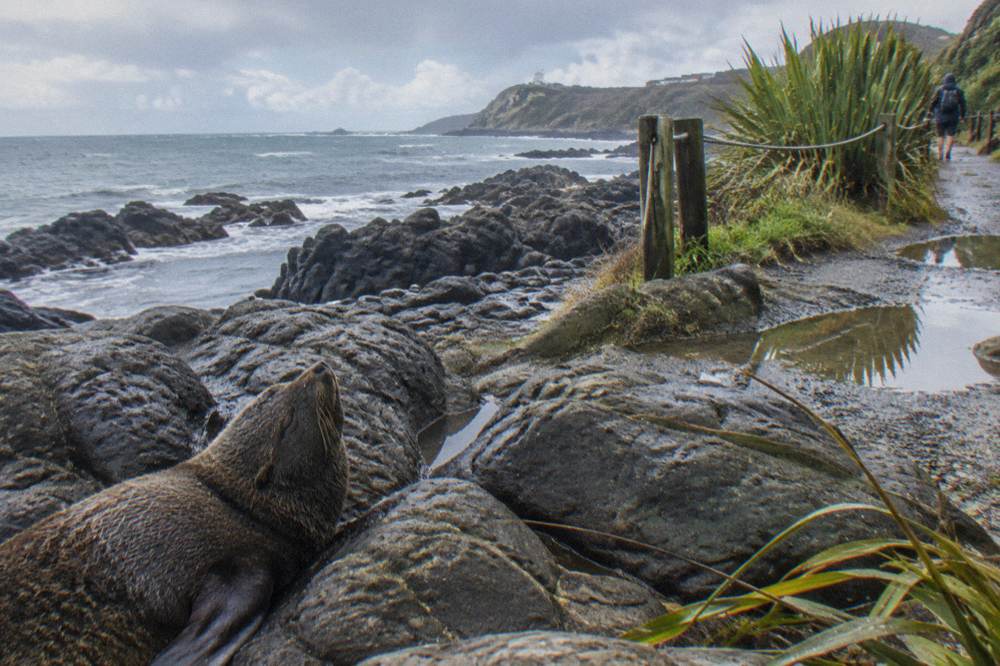
The question sounds playful, but it arrives in search logs every week, and it deserves a straight answer rather than a scolding. Seals genuinely do things that read as affection to a human eye. A kekeno, the New Zealand fur seal, will lie on its side waving a flipper in the air, scratch its own belly with a rear flipper, and rest in a posture that looks for all the world like a relaxed sunbather with hands folded behind the head. People see that and feel invited.
The invitation is imaginary. What looks like waving is usually an animal dumping heat through its flippers, which are rich in blood vessels close to the skin. What looks like a hug is a body position that conserves or sheds warmth depending on how it is angled to the sun and wind. The seal is managing its own temperature, not performing for you, and it has no way of understanding that your approach means well.
The rules follow the animal into the water, not just onto the sand. DOC asks swimmers to keep at least 5 metres from the water's edge where seals may be present, and vessels at least 20 metres. Drones are covered too: flying one near marine mammals requires authorisation from the Department of Conservation, and that includes private use. So the petting question is settled on land and at sea by the same logic, distance is the whole rule. A seal that swims over to you has not opened an exception, and backing away still applies. If you see harassment, injury or entanglement, call 0800 362 468 rather than stepping in yourself.
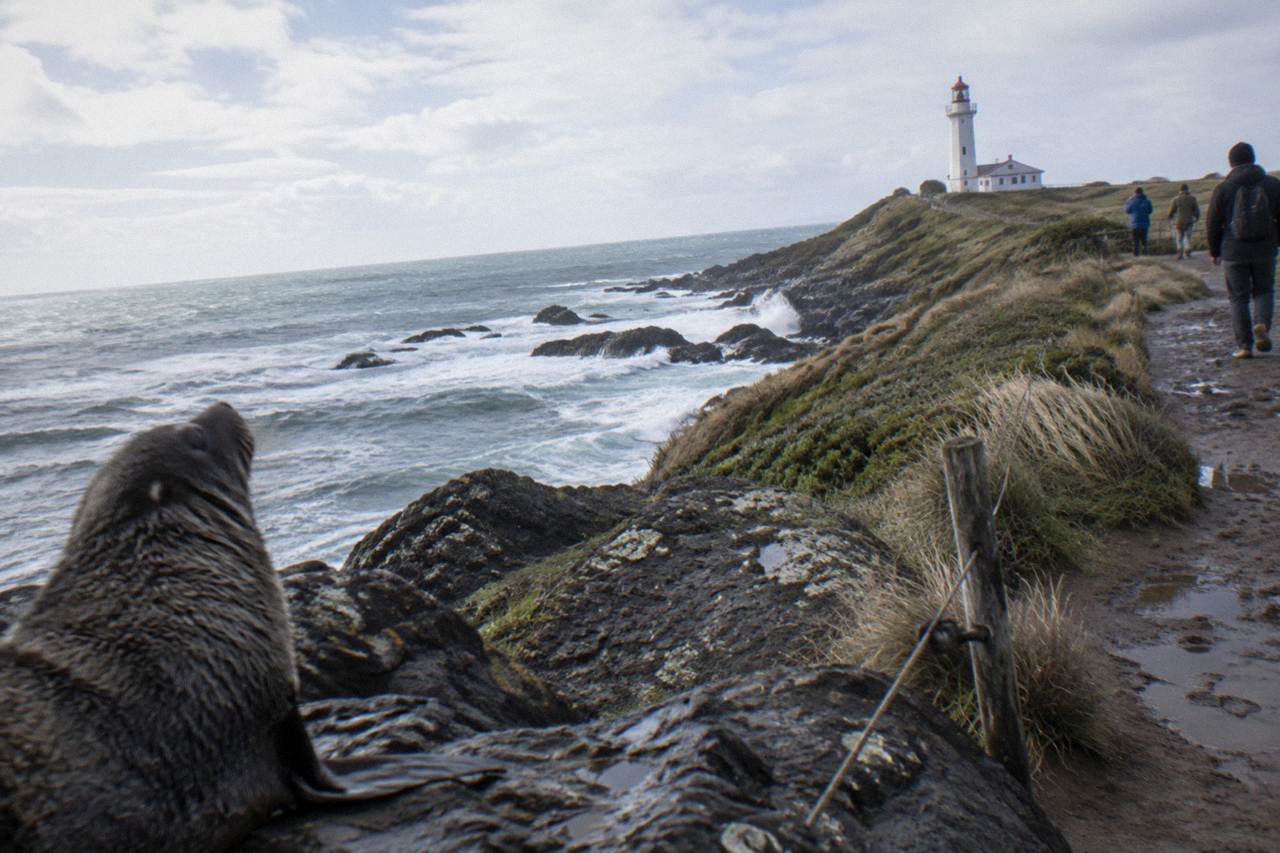
That gap between what the animal is doing and what people read into it is where most trouble starts. A person who believes a seal is being friendly will walk closer, lean in for a photo, and sometimes reach out a hand. The seal experiences a large land predator closing in. Its options are flight, which is exhausting and sometimes impossible over rocks, or fight, which a fur seal is well equipped for. Adult bulls and protective cows both bite, and bites from seals carry a high risk of infection because of the bacteria in their mouths.
There is also the legal frame, and it is not soft. The Department of Conservation is blunt on the point: never touch a seal. The protection applies to every seal on every beach in the country, from a lone bachelor hauled out on the south coast near Wellington to a breeding colony elsewhere. It does not pause because the animal looks calm, and it does not pause because the animal approached you first, which sometimes happens with curious juveniles.
The two most reviewed seal trips in the region are described in the comparison guide Wellington seal safari tours compared.
Why Does A Seal Look Like It Wants A Hug?
Seals spend long stretches hauled out doing almost nothing, and their resting postures happen to resemble relaxed human ones: lying back, flippers crossed or folded, eyes half shut. A thermo-regulating flipper wave completes the impression of a friendly greeting. None of this behaviour is directed at people, and a seal that appears to be lounging happily can react violently within a second of being approached.
The resemblance is coincidence, not communication. Fur seals evolved to rest on land for hours at a stretch between feeding trips, and a body that must alternate between cold water and wind-blasted rock needs flexible postures for temperature control. The crossed-flipper pose people photograph and caption as hugging is one of those postures. So is the nose-in-the-air sleeping position that looks like blissful dreaming.
Juveniles add to the confusion. Young seals, especially sub-adult males, are genuinely curious and will sometimes watch people, follow a walker along a beach at a distance, or pop their head up close to a kayak. Curiosity is not tameness. The same animal that watches you from the water will lunge if you corner it on shore, and a seal on land that feels trapped has nowhere sensible to go except through you.
Some background on the species helps explain the postures. The kekeno is the most common seal in New Zealand and its population is growing. DOC describes the social shape of a breeding group: adult males are called bulls, females cows, and their young pups, with a large breeding group known as a harem. Not every male breeds, and immature males, sometimes called sub-adult males or bachelors, use separate haul-outs from the breeding animals. That matters for anyone reading behaviour, because a young bachelor resting alone on a rock is not part of a family group and its tolerance for company is lower, not higher. Loneliness does not read as an invitation.
There is a welfare cost to a failed cuddle attempt even when nobody is bitten. The Department of Conservation warns that pups can be abandoned if disturbed, and that a mother separated from her pup by an approaching human may not return. The principle holds everywhere: disturbance costs the animal energy it has budgeted carefully, and in the worst case it costs a young seal its mother.
The self-guided alternative carries all of this responsibility alone. The council's Red Rocks walk is covered in detail in the Red Rocks walk versus seal safari guide, including the Sunday vehicle gate at Owhiro Bay and why the unsealed route is not for a 2WD rental.
What Are The Seal Rules On The Wellington South Coast?
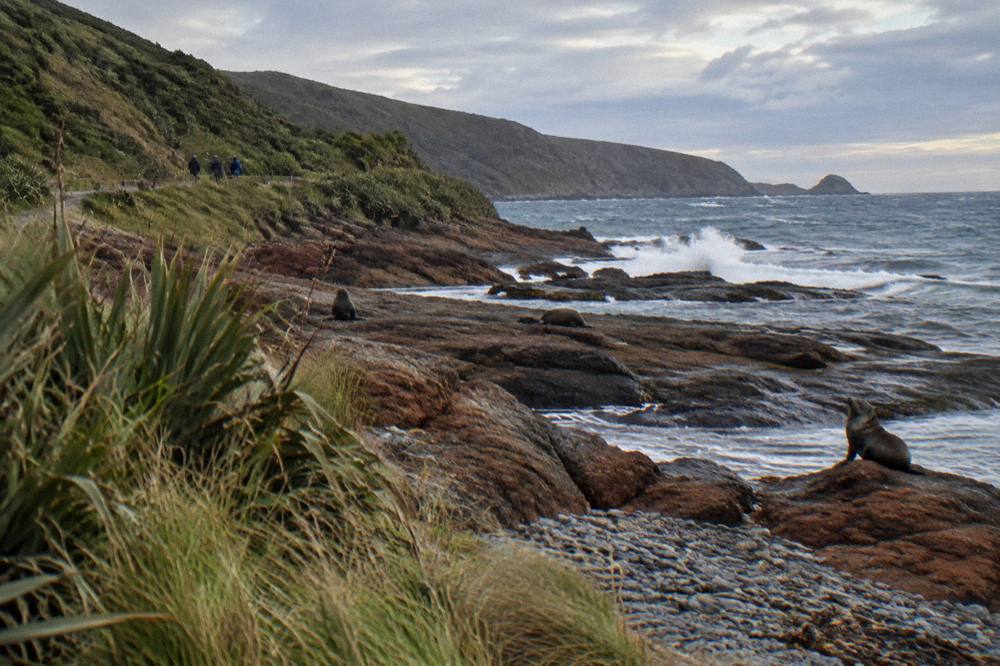
Keep at least 20 metres from seals on shore where you can, never get between a seal and the sea, keep dogs on a lead and well away, do not drive closer than 50 metres to a marine mammal where you can avoid it, never touch, feed or take selfies with a seal, and drones need DOC authorisation. These rules come from the Department of Conservation and apply on every beach and reserve around Wellington.
The Taputeranga Marine Reserve, established in 2008, covers 855 hectares of the south coast starting about 6 kilometres from the city centre. Its rules sit on top of the general marine mammal protections: no fishing or gathering of marine life, dogs on a lead, and a specific instruction not to feed seals or take selfies with them. That selfie line surprises people, but the logic is simple. Framing a selfie pulls your attention off the animal, pulls your body closer than you intend, and produces exactly the approach behaviour the distance rules exist to prevent.
| Rule | Distance or action | Applies to |
|---|---|---|
| Onshore distance from seals | At least 20 m where you can | Any beach or rocky shore |
| Between a seal and the sea | Never position yourself there | All seals on land |
| Vehicles near a marine mammal | Do not drive closer than 50 m where you can | Unsealed coastal routes |
| Vessels where seals may be present | At least 20 m from the water's edge | Boats, kayaks |
| Swimmers | At least 5 m | People in the water |
| Touching, feeding, loud noise | Never | Everywhere |
| Dogs | On a lead and well away | All coastal reserves |
| Drones near marine mammals | DOC authorisation required | Everywhere |
Harassment, injury or entanglement can be reported on the DOC hotline, 0800 362 468. That number is worth saving in your phone before a south coast walk, because a seal in trouble, tangled in rope or fishing line, needs a trained response rather than a well-meaning hands-on rescue. An untrained person who grabs an injured seal is likely to be bitten and may make the injury worse.
The land under your feet carries its own protections. Red Rocks Scientific Reserve was created in 1972 after public concern about quarrying, and the red rocks themselves are ancient volcanic pillow lava embedded in greywacke with red and green siltstone. So the setting is protected geology as well as protected wildlife, and the penalties in the Taputeranga Marine Reserve are serious: gear, vessels or vehicles can be confiscated, with fines up to $250,000 and up to three months imprisonment. Dog owners are penalised if their dogs disturb wildlife, which is why the lead rule is not a courtesy. Check nothing, take nothing, and leave the rock where it lies.
How Close Can You Get To Seals On A Seal Safari?
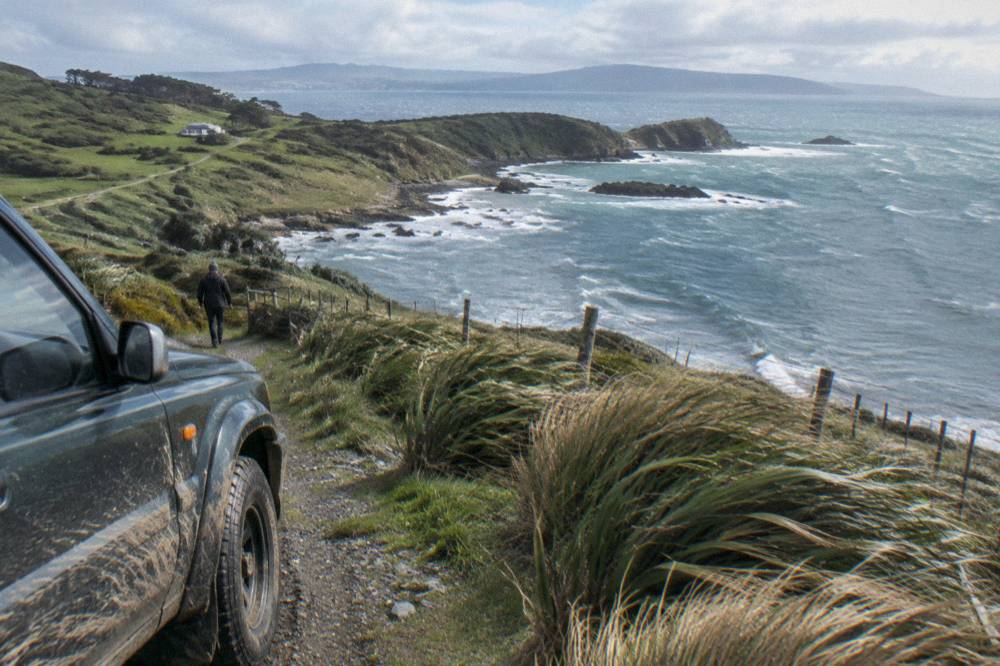
On the Exclusive Access Seal Coast Safari the itinerary crosses private farmland to Cape Terawhiti by 4WD, from $111.80 per person, rated 4.9 across 371 reviews.
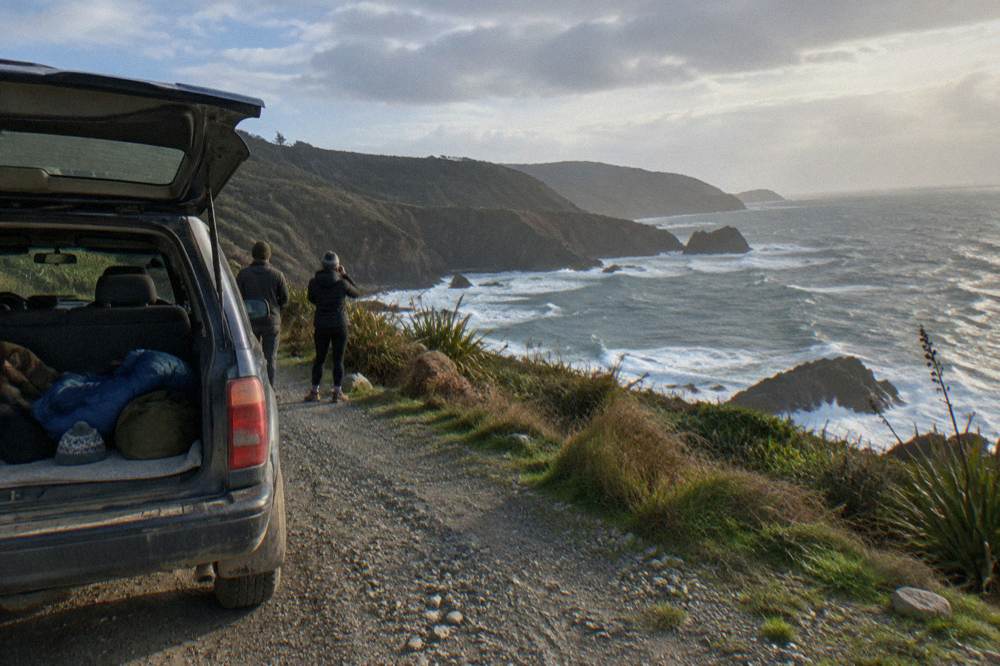
That tour, run by Seal Coast Safari, picks up from your Wellington hotel or cruise ship and runs 3 hours 30 minutes, with a group capped at 10. Its route takes in Otari-Wilton's Bush, then Terawhiti Station, then Cape Terawhiti. The seals are named on the itinerary, and the booking page does not mention a sighting guarantee: weather and the animals decide, which is the honest position every wildlife operator should hold. The full index of guides sits on Wellington Seal Safari.
The same safari is sold on a second booking page, the Wanderlust Half Day Seal Safari, from $110.00 per person with central Wellington or cruise terminal pickup, rated 4.9 across 342 reviews. It covers the same 3 hours 30 minutes by 4WD. Weather handling differs between the two booking pages: the Exclusive Access trip requires good weather and offers a different date or a full refund if poor weather cancels it, while the Wanderlust trip runs in all weather with routes that may change and bookings that can be moved at no charge with at least 24 hours notice.
Group size shapes how a viewing stop actually runs. The Exclusive Access Seal Coast Safari page caps the group at 10, while the second booking page for the same safari states no cap at all, so ask when you book if a small party matters to you. Guide staffing is another per-tour detail: neither seal safari page states a guide, so assumptions either way are unsafe. For a trip where a guide is stated and seals are named on the itinerary, the Private Full Day, Meal Included tour from Capital Personalised Tours runs 7 hours with lunch from $206.40 per person, rated 4.8 across 82 reviews, and includes a Red Rocks stop in a private vehicle. The discipline question remains yours on foot either way.
Why does the guided version matter for the petting question? Because distance is a group discipline, and groups drift. One person steps two paces forward for a photo, the next matches them, and within a minute the whole party has halved the gap. If you are weighing a self-drive against a guided day, the piece on seal safari or hire car on the Wellington south coast walks through the trade-offs.
What Happens If You Touch Or Feed A Seal?
You commit an offence under the Marine Mammals Protection Act 1978, with penalties up to two years in prison or a $250,000 fine, and you expose yourself to a serious bite. Seal mouths carry bacteria that make their wounds notoriously prone to infection, and a fur seal that feels cornered moves faster than most people expect across wet rock.
Feeding is its own category of harm, separate from touching. A fed seal learns to associate people with food, which is why DOC asks people not to feed seals.
The physical risk is real even in a shallow encounter. A fur seal's bite is a grab-and-shear action, and their teeth are built for holding slippery fish. There is a whole companion piece on the consequences at what happens if a seal bites you, but the headline is that seal bite wounds need prompt medical attention and antibiotic cover, and the seal involved is generally the one that pays the heavier price afterwards.
People sometimes argue the animal consented because it came close. It did not consent to anything; it made a judgement about threat level with a brain tuned for predators, not for intentions. A curious juvenile that approaches you is still a wild animal making second-by-second decisions, and the DOC guidance holds regardless of who closed the distance first. You are the party capable of understanding the law and the welfare consequences, so the responsibility sits entirely with you.
Can Children Go On A Wellington Seal Tour?
No minimum age is stated on the Seal Coast Safari booking pages, so check the booking page for children. Zealandia lists a minimum age on only two tours, 5 for the twilight tour and 12 for the night tour, while the Seal Coast Safari booking page notes the trip is not recommended for travellers with back, neck or heart conditions or who are pregnant.
The full picture on ages, including why a bumpy 4WD track shapes the advice, is laid out in the guide to Wellington seal safaris with children. In short, the half-day format suits families better than a long day trip, and the guide on board handles the wildlife rules so parents are not policing rock-hopping and photo distance at the same time.
Children are actually the audience that benefits most from a guide's presence, for the opposite reason you might assume. Kids do not reach for seals out of disrespect; they reach because the animal looks like the plush toy on their bed. A guide who explains what the flipper wave really means, heat dumping, not waving, converts the impulse into something more interesting than a touch would have been. DOC guidance asks visitors to stay at least 20 m back from seals where possible, and a structured tour is the easiest way to hold that line without a constant stream of "no" from a parent.
For a private option, the Private Full Day, Meal Included trip from Capital Personalised Tours includes a Red Rocks stop where seals are named on the itinerary alongside Mount Victoria, the Cable Car and the Weta Cave. It runs 7 hours with lunch, from $206.40 per person, rated 4.8 across 82 reviews, with hotel or port pickup. A private guide means the pace and the pauses are yours, useful with young children or anyone who wants longer at the coast.
Should You See Wellington's Seals With A Guide Or On Your Own?
Go on a safari if you want the distance rules handled for you, private farmland access you cannot drive yourself, and a group cap that keeps the encounter calm; go on your own to the free council walk at Red Rocks if you would rather walk the 7.4 km return track from Owhiro Bay and accept the discipline of holding 20 metres yourself. The cheapest seal trip is $110.00 per person for 3 hours 30 minutes.
The self-guided route costs nothing and rewards preparation. The Pariwhero Red Rocks Coastal Walk is an easy, flat 7.4 kilometre return track taking 2 to 3 hours from the car park at the end of Owhiro Bay, past early-1900s baches to Devil's Gate at Te Rimurapa. The council says you can meet the kekeno in winter just beyond Pariwhero. The unsealed route is uneven and unsuitable for a 2WD; the gate is closed to vehicles on Sundays though walkers and mountain bikers can still pass.
What the free walk cannot give you is Terawhiti Station. The Exclusive Access safari's seal ground sits on private farmland that a rental car has no right to enter, reached by 4WD with an operator who holds that access. That, more than anything, is what you are buying on a seal safari around Wellington, together with the certainty that nobody in your group becomes the person in the DOC incident report.
Common Questions About Petting Seals In Wellington
Can You Pet A Seal If It Hugs You?
No. A seal lying back with crossed flippers is thermo-regulating, not hugging, and touching a seal is an offence under the Marine Mammals Protection Act 1978 with penalties up to two years in prison or a $250,000 fine.
How Close Can You Get To A Seal In New Zealand?
DOC advises at least 20 metres on shore where you can, never between a seal and the sea, at least 20 metres by vessel from the water's edge where seals may be present, and at least 5 metres for swimmers.
Why Can't You Take Selfies With Seals?
Selfies pull your attention and your body closer than you intend, and the Taputeranga Marine Reserve rules name them directly. Framing a shot with your back to a wild animal removes the margin the distance rules exist to protect.
Are Wellington Seals Dangerous?
They can be. A cornered or surprised fur seal bites fast, and seal bites carry bacteria that make wounds prone to infection. The safe response is distance, which is what a guided trip maintains for the whole group.
Do Seal Safari Tours Guarantee A Sighting?
No operator on this site promises a sighting. Seals are named on the itineraries of the two Seal Coast Safari booking pages, the two Cape Palliser day trips and the private full-day sightseeing tour, and the animals decide the rest.
What Should You Do If A Seal Approaches You?
Stay still or move slowly away, keep at least 20 metres where you can, and never reach out, even if the animal closes the distance. Curiosity is not an invitation, and the responsibility stays with you.